
I/O buffering

After solving the “iofile_aw” wargame from dreamhack.io, I found out that _IONBF is not exactly NO Buffer but rather using just 1-byte. (Hence making the buffer to flush on every input byte.)
I got curious and thought, “What’ll happen if the buffer is set to Full or Line?”
// gcc -o test test.c -no-pie -fno-pie
#include <stdio.h>
#include <unistd.h>

void initialize() {
    setvbuf(stdin, NULL, _IONBF, 0);
    setvbuf(stdout, NULL, _IONBF, 0);
}

int main() {
	// initialize();

	printf("hello buffer");
	sleep(3);

	return 0;
}
I tested two scenarios with the code above.
- When will
“hello buffer”be printed wheninitialize()is enabled? - When will
“hello buffer”be printed wheninitialize()is disabled? Or will it be printed in the first place?
The result was interesting!
For the question no.1, the code kind of speaks for itself. “hello buffer” is printed right after the printf() is executed.
But for the Q no.2, the logical result for me was the code Not printing anything at all. Because buffer is obviously not full yet!
But the "hello buffer" was printed after 3 sec of sleep() !
pwndbg
While going through the printf("hello buffer"); , __vfprintf_internal was called and _IO_2_1_stdout_ was updated like below. (Original value of _IO_buf_base and other _IO_ values were 0)
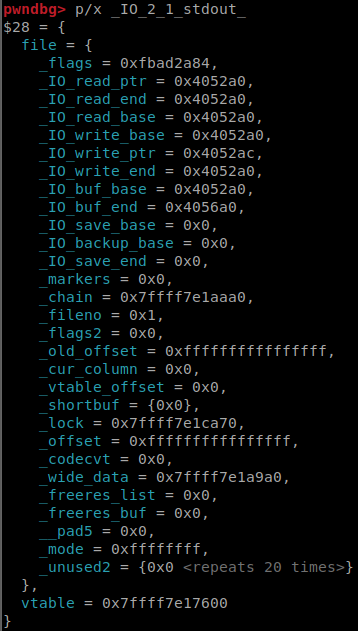

The string is not yet printed!
- At the end of the asm,
exit()is called.- Inside the
exit(),_IO_cleanupis called.- Inside the
_IO_cleanup,_IO_flush_all_lockpis called.
- Inside the
- Inside the
with this process the address of "hello buffer" is passed to the rsi .
The string is then printed to the console using SYS_write and IO is cleaned up by _IO_cleanup .
참고로 Ubuntu 22.04 환경에서는
- stdin 의
_flags는 0xfbad2088 - stdout 의
_flags는 0xfbad2084
로 둘 모두 File Buffer 즉 Full Buffer(0x2000) 를 default 로 사용했다.
uname -r : 6.5.0-35-generic